Best sales and GTM communities to join in 2026
Sales and GTM communities compared by who they suit, cost and format: RevGenius, RevOps Co-op, Modern Sales Pros, Pavilion and more, plus how to start your own peer group.
The short answer
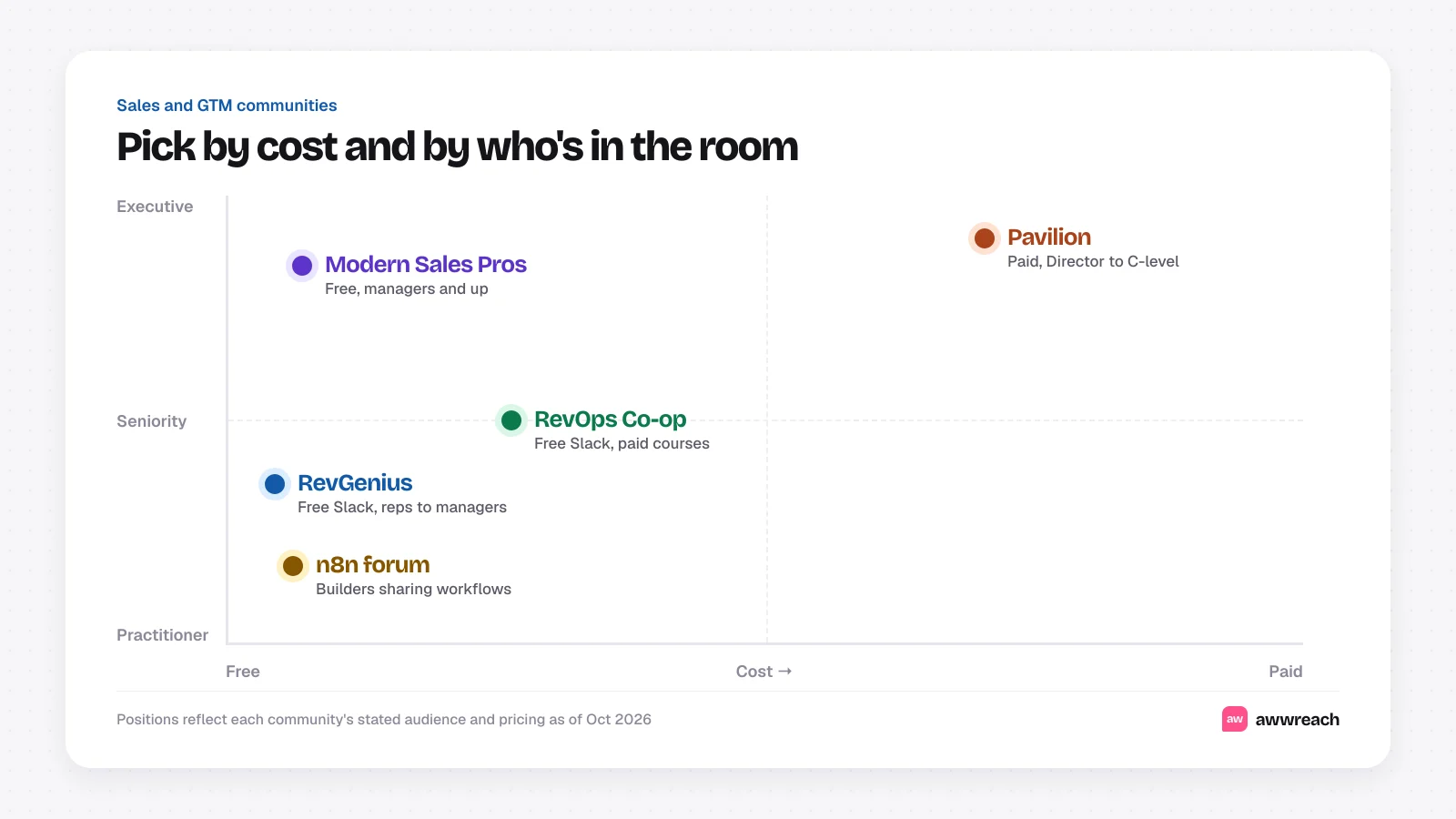
Pick a sales community by your role and what you need from it. Practitioners who want tactics and fast answers do well in free Slack groups like RevGenius or RevOps Co-op. Senior leaders who want vetted peers lean toward application-based groups like Modern Sales Pros or paid ones like Pavilion. For AI and automation workflows, tool communities such as Clay's and n8n's are where builders share working setups. Join one, give before you ask, and consider a small private peer group of six to eight people for the conversations a big Slack can't hold.
On this page
#The short list
Member counts below come from each community's own site where they publish one. Pricing and entry rules change, so check before you apply.
| Community | Best for | Cost | Format | How you get in |
|---|---|---|---|---|
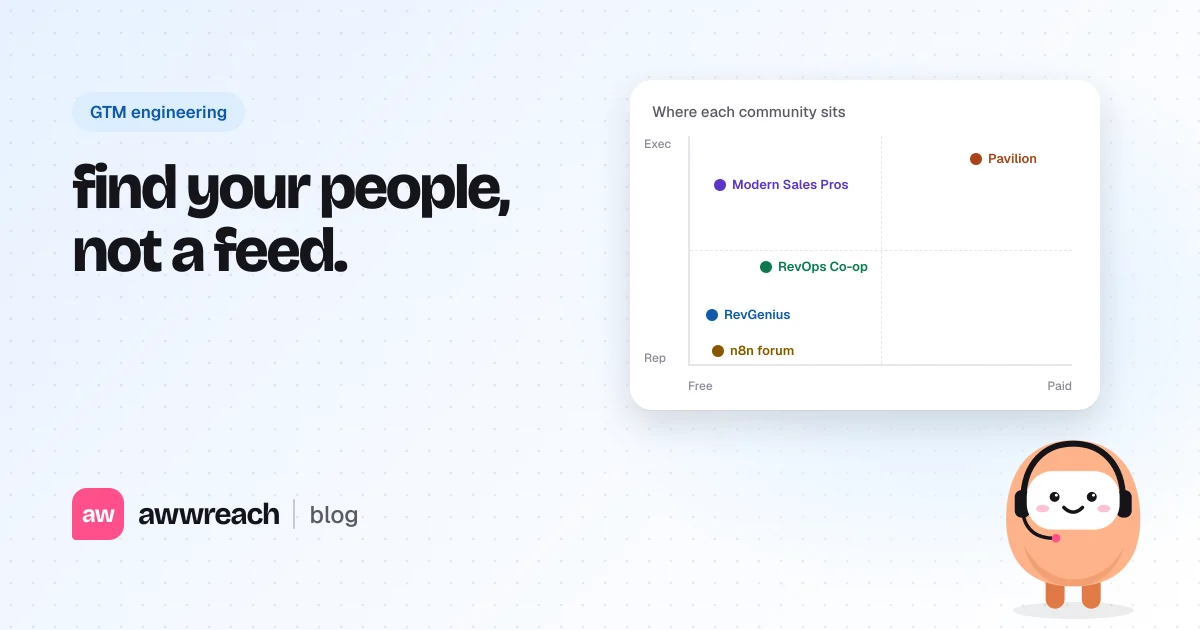
| RevGenius | SDRs, AEs, RevOps and marketers early to mid career | Free core community | Slack, virtual and live events | Open sign-up |
| RevOps Co-op | Revenue operations practitioners and GTM engineers | Free Slack, paid courses and certification | Slack, local chapters, conferences | Open sign-up |
| Modern Sales Pros | Sales, sales ops and enablement managers and up | Free | Forum, events | Application, no individual sellers |
| Pavilion | Directors, VPs and C-level GTM leaders | Paid membership | Slack, chapters, courses | Application, vetted by role |
| n8n community | GTM engineers building automation | Free | Forum | Open sign-up |
#Communities for practitioners
RevGenius says it has 60,000 members, and its Slack is busy enough that a question about a sequencer setting or a comp plan usually gets several answers the same day. It's free and has no application, which makes it a good first stop for reps and early-career RevOps.
RevOps Co-op lists 21,000+ members and stays focused on operations: CRM architecture, routing, data hygiene, tooling. GTM engineers who own CRM fields or reply routing will find more relevant threads here than in a general sales group.
#Communities for GTM executives
Senior leaders usually want fewer, better conversations with people carrying the same number. Two groups dominate.
Modern Sales Pros is free but application-based. Its site lists 35,000+ members and limits entry to people managers in sales leadership, sales and revenue operations, and enablement, so individual sellers can't join. The forum format suits slower, more considered questions like “how did you restructure territories after a reorg?”
Pavilion is a paid membership for GTM leaders, with an application that checks your role. Its site describes 5,000+ executives, local chapters and Pavilion University courses. It's the most structured option on this list and the most expensive, so it fits best when your company pays and you'll actually attend chapter events.
#Where GTM leaders swap practical AI workflows
Ask “how are you using AI in outbound?” in a general sales Slack and you'll get opinions. Ask in a tool community and you'll get screenshots. A few places worth knowing:
- Tool communities. Clay's own community and its local meetups, and the n8n forum, are where builders post working tables and workflows you can copy.
- Pavilion's AI programme. Pavilion advertises an AI in GTM School (an eight-week certified course) and a group of 2,000+ operators focused on AI in GTM.
- Practitioner Slacks. RevGenius and RevOps Co-op both have channels where people share prompts, enrichment setups and what broke.
#Start your own go-to-market peer group
Big communities are great for answers and weak for candour. Nobody shares their real pipeline numbers in a 60,000-person Slack. A private peer group of six to eight people at a similar stage fills that gap. Here's a format that holds up.
- Pick six to eight people at the same stage
Similar company size and role, different companies, no direct competitors. Two or three from your network, then ask each to bring one.
- Meet every two weeks for 45 minutes
Same time, video on, no recordings. Consistency matters more than length.
- Use a hot-seat format
One person brings a real problem with numbers. Ten minutes to explain, twenty for questions and ideas, five to commit to a next step.
- Share one metric each time
Pick a shared one, like meetings booked per week or positive reply rate. Trends over months are where the learning is.
- Keep it confidential and small
Agree on the rules in the first session. Don't grow past eight. Start a second group instead.
#Free outbound roleplay groups
Public roleplay channels come and go. The most reliable option is to run your own with three or four reps from other companies.
- Meet weekly for 30 minutes on video.
- Rotate roles: one rep plays buyer, one sells, the others score.
- Use real objections from your last week of calls, written on cards beforehand.
- Score two things only: did the seller find the problem, and did they earn a next step.
- Swap one recording a month for written feedback.
#Getting value in your first 30 days
- Week 1: read, don't post
Learn the channel norms and who answers well. Note five people whose answers you'd trust.
- Week 2: answer three questions
Pick questions where you have direct experience. Specifics beat general advice.
- Week 3: ask one good question
Include context, what you tried and the numbers. You'll get far better answers.
- Week 4: move one conversation off the group
Connect on LinkedIn with someone you've traded useful messages with, and mention the thread. That's how a community turns into a network.
#Pick one and show up
The best community is the one you'll check twice a week. Start with one that matches your role today, give useful answers for a month, and add a small peer group when you want honest numbers. Two good communities beat six you never open.
Frequently asked questions
For most reps and early-career RevOps, RevGenius is the largest free option. RevOps Co-op is the best free choice for operations-focused roles.