How GTM teams scale outbound with always-on playbooks
Why one-off outbound pushes stall, what 486 published signal playbooks have in common, and a four-part system for shipping a new outbound play in days, not quarters.
The short answer
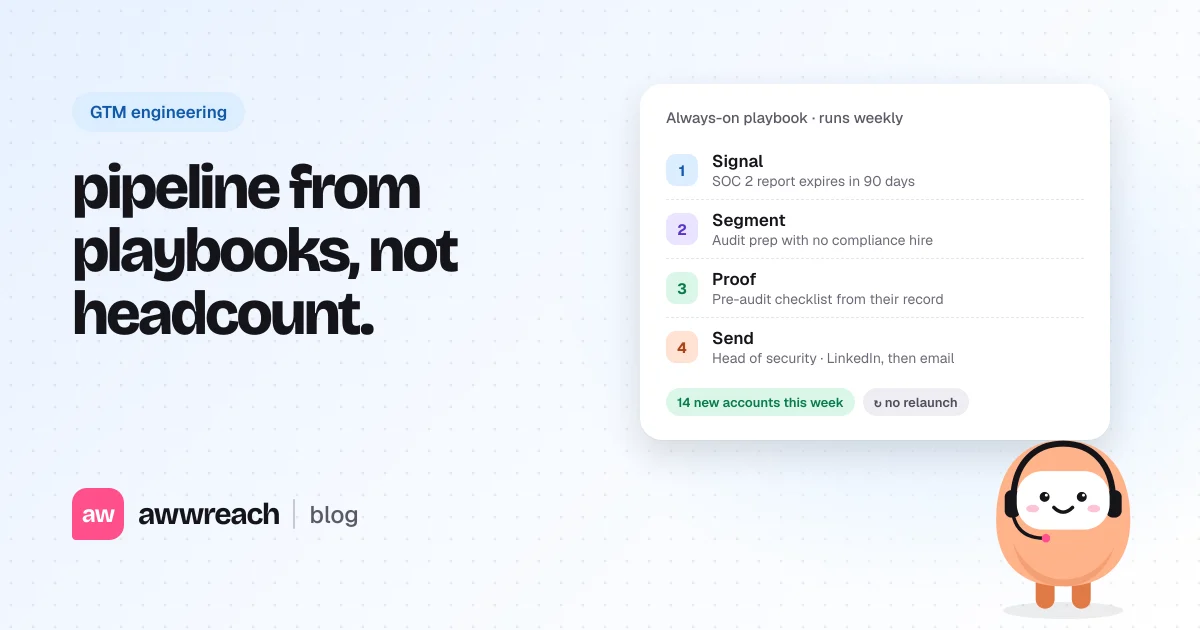
Outbound scales when each motion is a playbook that runs every week, not a push someone rebuilds every quarter. A playbook has four parts: a signal you can detect from data, a segment defined by a problem rather than a job title, a piece of proof you hand over before asking for anything, and send rules that decide who gets what and when. Build those once, and launching the next play takes days because only the signal and the proof change.
On this page
- Why outbound stalls when every push starts from zero
- What 486 published playbooks have in common
- The two ideas underneath: PQS and PVP
- The always-on playbook, in four parts
- Shipping a new play in days, not a quarter
- Six plays a B2B SaaS team can run this quarter
- Where LinkedIn fits in an always-on motion
- Run fewer plays and keep them running
- FAQ
#Why outbound stalls when every push starts from zero
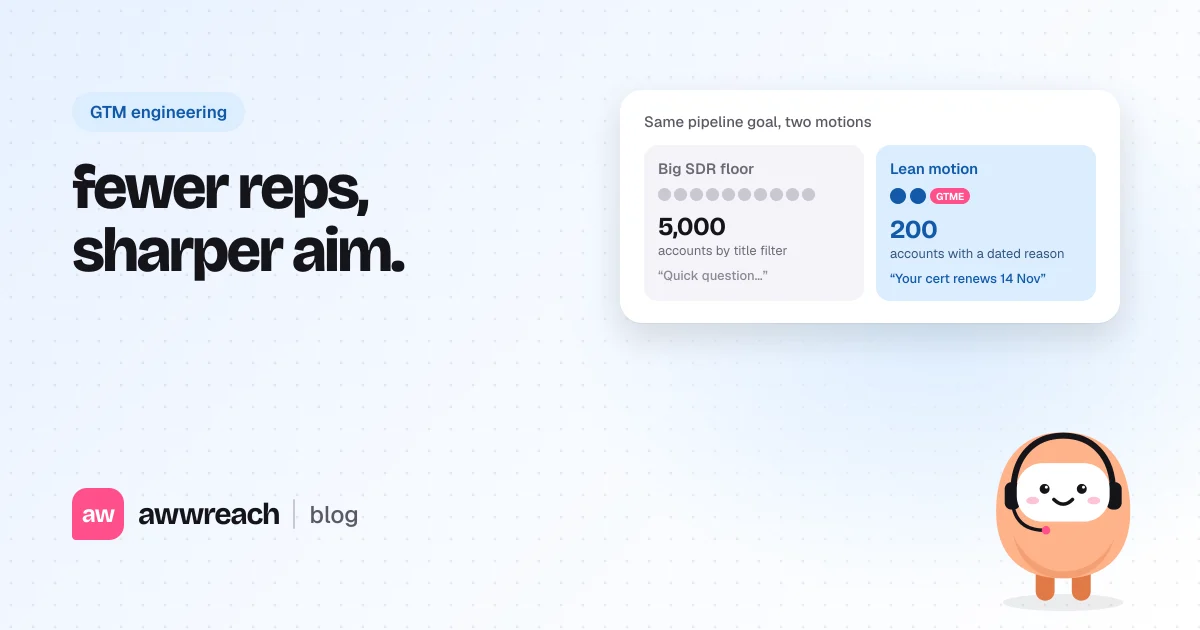
Picture the usual quarter. A leader asks for pipeline. Someone pulls a list by title and headcount, writes four emails, loads them into a sequencer and launches. Replies trickle in for two weeks, then the list is spent. Next quarter the same people rebuild the same thing with a slightly different list.
The work that actually decides results, figuring out who has the problem right now and what to say about it, gets redone every time and thrown away every time. That's why deploying a new outbound motion feels slow. The sequencer is fast. The thinking around it has no home.
An always-on playbook gives that thinking a home. The signal query, the segment logic, the proof asset and the send rules live in a system. When the play keeps finding new accounts each week, it never needs relaunching. When you want a new play, you copy the frame and swap two parts.
#What 486 published playbooks have in common
Jordan Crawford's team at Blueprint GTM publishes its client playbooks on a public showcase. On 4 October 2026 we read all 486 and tagged the signal each one runs on. The pattern is hard to miss.
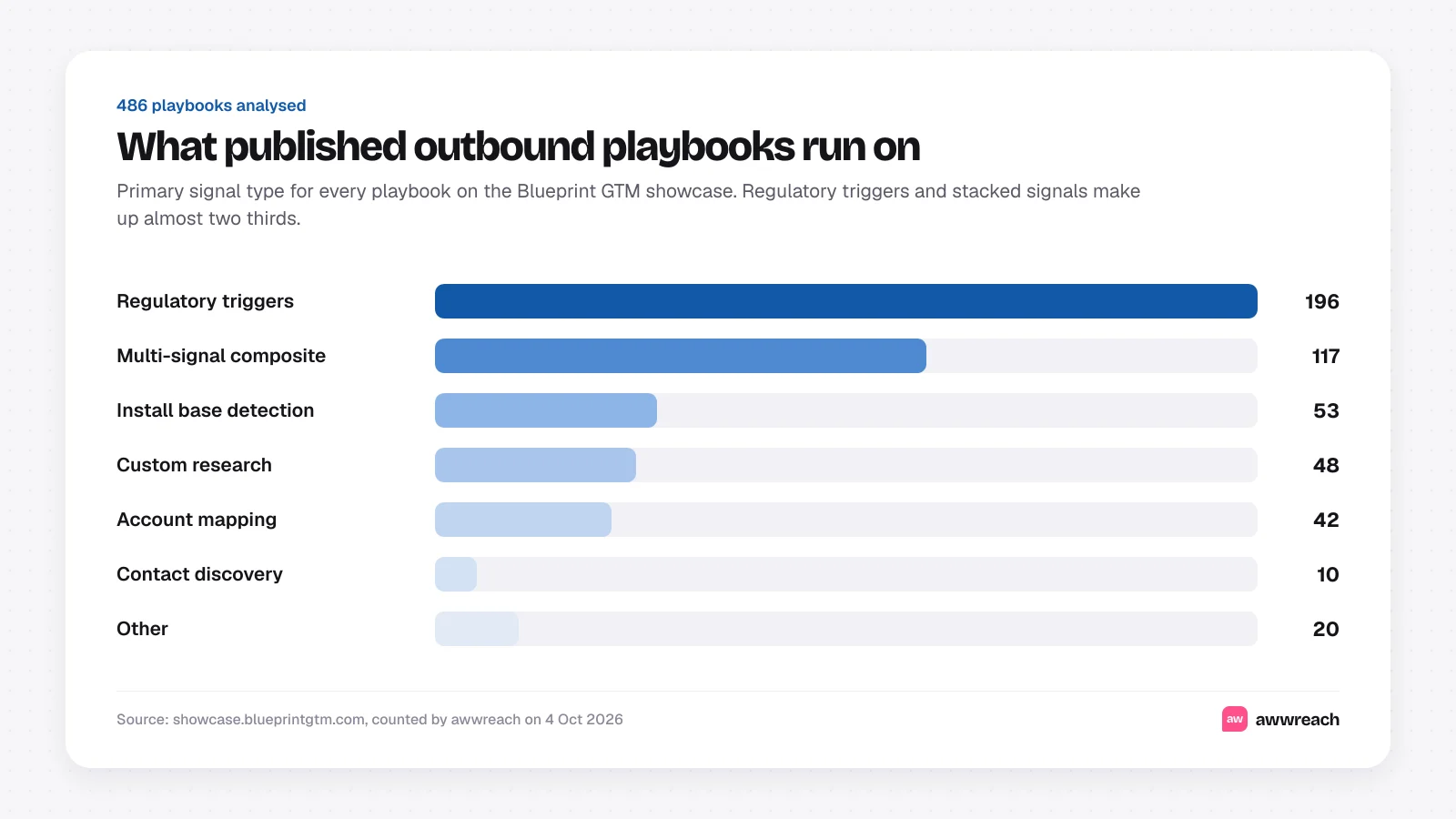
Regulatory triggers lead with 196 playbooks: an inspection, a citation, a license renewal or a filing deadline that creates a dated, provable problem. Next come composites (117) that stack two or three sources, like a safety citation plus a hiring surge. Install base detection (53) finds accounts already running a product you sit next to.
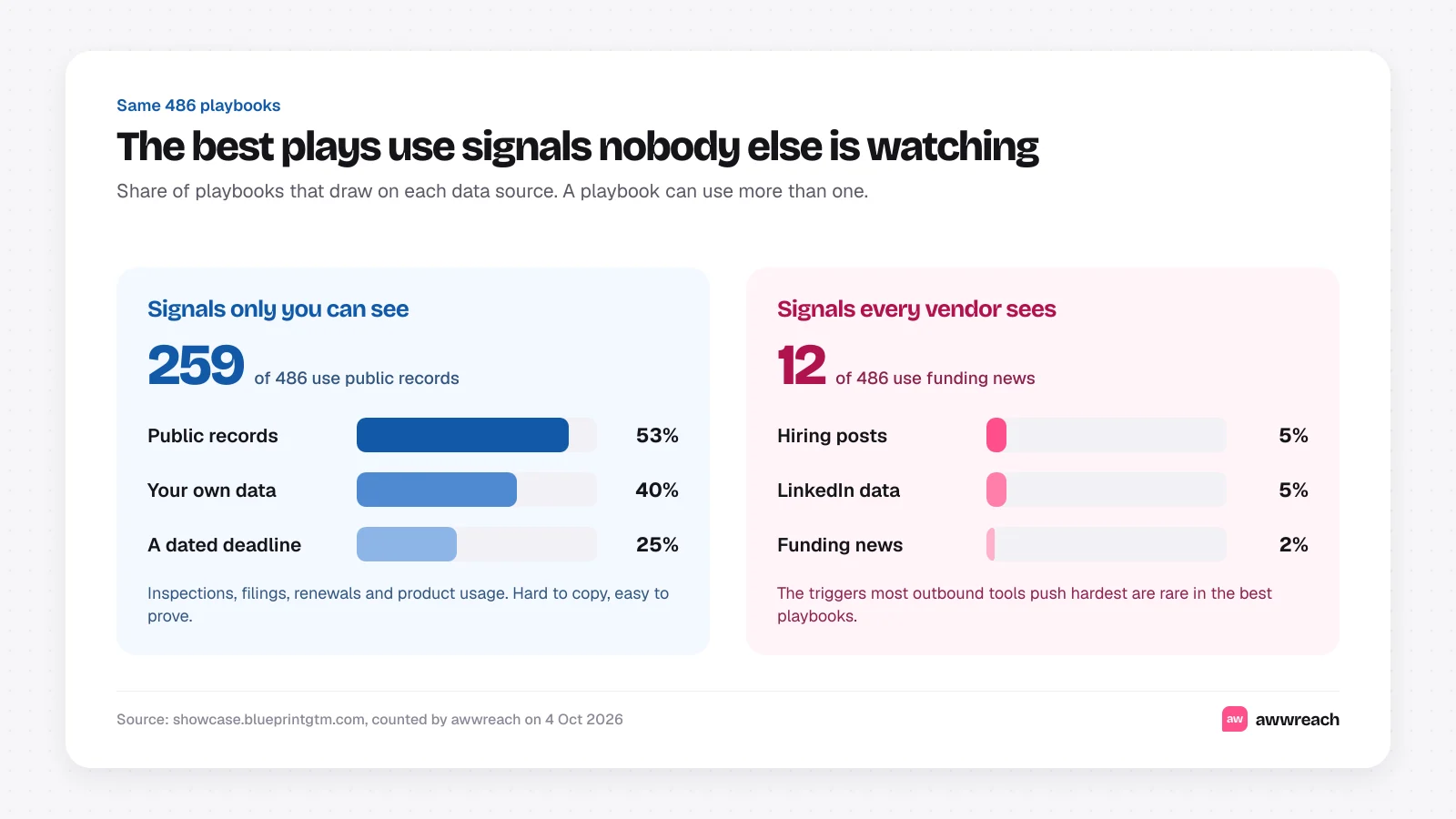
The signals outbound tools push hardest barely show up. Only 23 playbooks (5%) use hiring posts, 22 (5%) use LinkedIn data at all, and 12 (2%) use funding news. Meanwhile 259 (53%) pull from public government or regulator records, 194 (40%) use the seller's own first-party data, and 121 (25%) hinge on a deadline, renewal or expiry date.
#The two ideas underneath: PQS and PVP
Blueprint describes its method with two terms. A pain-qualified segment (PQS) is a group of accounts defined by a specific problem you can detect in data right now, not by firmographics. A permissionless value prop (PVP) is a message that hands over something useful on its own, like a finished analysis or a deadline already pulled, so the reader gets value whether or not they reply.
A quick test from the framework: read your value line and ask if you could send it to a different company by changing only the name. If yes, it's generic. If swapping the name would break the sentence, you've done the homework.
#The always-on playbook, in four parts
- Signal: a query that finds new accounts every week
Write it as a data question with a date in it. “Companies whose SOC 2 report expires in the next 90 days” works. “Mid-market fintech” doesn't. If the query returns zero new rows most weeks, the play isn't always-on.
- Segment: the problem, stated the way the buyer would say it
One sentence that names the situation and its cost. Pull the wording from won-deal call notes, not from your homepage.
- Proof: the thing you give before you ask
A benchmark, a checklist built from their own record, a short teardown. It should take your system seconds to produce per account and save the reader real time.
- Send rules: who, which channel, how many
Decide the role to contact, the first channel, the pace per sender and when to stop. Write these down so a new rep or an AI agent runs the play the same way you would.
Keep each part in its own place. The signal lives in your data tool, the segment and proof live in a shared doc with examples, and the send rules live in the sending tool's settings. When results dip, you can see which part broke.
#Shipping a new play in days, not a quarter
Once the frame exists, a new outbound motion only needs a new signal and a new proof asset. Everything else carries over. Here's where the time goes in each approach.
| Stage | One-off push | Playbook frame |
|---|---|---|
| Pick who to contact | New list pull, title filters, debate | Write one signal query |
| Decide what to say | Fresh copy from a blank page | Fill the segment sentence and swap the proof |
| Build the asset | Rarely done, too slow by hand | Template once, generate per account |
| Set sending rules | Re-entered in each tool | Inherited from the frame |
| Review results | End of quarter | Weekly, per play |
The weekly review is the part that compounds. Look at each play's new accounts found, replies, positive replies and meetings. Kill the bottom play every month and replace it with a new one built on the same frame.
#Six plays a B2B SaaS team can run this quarter
Adapted from patterns in the showcase. Each names the signal, where it comes from and the proof you'd send.
- Compliance renewal window. Signal: certification or audit dates from public registries. Proof: a pre-audit checklist mapped to the standard they're renewing against.
- Install base adjacency. Signal: companies running a tool you integrate with, detected from their site or job posts. Proof: the three workflows your integration removes, with screenshots.
- Complaint velocity. Signal: a jump in public reviews or complaints mentioning a problem you fix. Proof: their own quotes grouped by theme, with counts.
- Post-acquisition overlap. Signal: an announced acquisition. Proof: a map of the duplicate tools and teams the two companies now run.
- Leader in a new seat. Signal: a new VP in the role you sell to. Proof: a 90-day starter plan for their remit, written for their company size.
- Your own product data. Signal: free or trial accounts hitting a usage pattern that preceded upgrades. Proof: a benchmark showing where they sit against similar accounts.
#Where LinkedIn fits in an always-on motion
Email carries the proof well. LinkedIn is where a buyer checks whether you're a real person worth answering. A light warm-up before the first email (a profile visit, a follow, a genuine comment on a recent post) means your name is familiar when the message lands.
In awwreach, a GTM engineer can feed a play's account list in from Clay, Sales Navigator or a CRM, then run a LinkedIn flow that warms people up and sends a connection request whose note names the signal. Replies go back to HubSpot, Salesforce or an n8n webhook so the play's numbers stay in one place.
#Run fewer plays and keep them running
Pipeline from outbound grows when the number of working plays grows, not when the list gets longer. Start with one play you can describe in a sentence, prove it weekly for a month, then build the second one on the same frame. Three plays that run every week will outlast any single quarter-long push.
Frequently asked questions
A repeatable outbound motion with a fixed signal, segment, proof asset and send rules. It finds new accounts every week on its own, so it runs continuously instead of being relaunched each quarter.